Choosing between a centrifugal pump and a positive displacement (PD) pump is one of the first decisions in any offshore pumping application, and getting it wrong shows up quickly — either as poor performance or as unnecessary wear. The two work on fundamentally different principles, and each fits a different kind of job.
What centrifugal pumps are
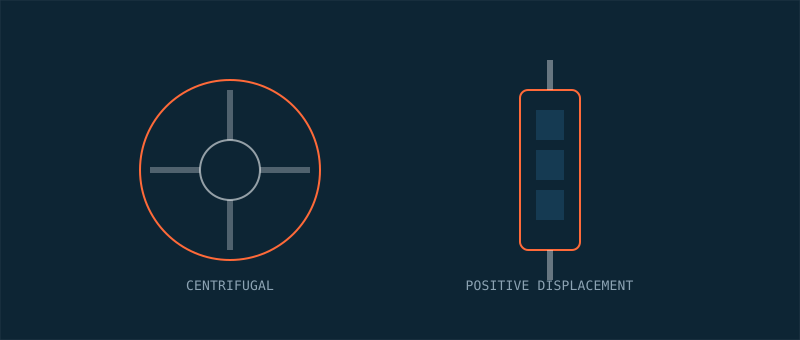
A centrifugal pump moves fluid by spinning an impeller, which accelerates the fluid outward and converts that velocity into pressure as it exits the casing. It's a continuous-flow design with no trapped volume of fluid moving through the pump at any point.
What positive displacement pumps are
A PD pump moves a fixed volume of fluid with each cycle — through gears, lobes, screws, diaphragms, or pistons, depending on the type. Flow is directly tied to the pump's speed rather than to the pressure it's working against.
Operating principles compared
This distinction matters most under changing conditions. A centrifugal pump's flow rate drops as system pressure (head) rises. A PD pump's flow rate stays roughly constant regardless of pressure, up to its mechanical and power limits — which is also why PD pumps need relief protection against dead-heading.
Flow characteristics
Centrifugal pumps produce smooth, continuous flow well suited to high-volume transfer. PD pumps produce a more constant, often pulsing flow (depending on type), which makes them well suited to metering and dosing applications where precise, repeatable flow matters more than raw volume.
Pressure capabilities
Centrifugal pumps are generally suited to low-to-moderate pressure, high-flow duties. PD pumps can generate much higher pressures at lower flow rates, which is why they show up in hydraulic systems and high-pressure injection duties.
Fluid viscosity
Centrifugal pump efficiency drops sharply as fluid viscosity increases — thick fluids don't accelerate cleanly through an impeller. PD pumps handle viscous fluids far more effectively, since they physically displace the fluid rather than relying on velocity.
Typical offshore applications
Centrifugal pumps are common for seawater transfer, cooling water, ballast and general bulk transfer duties. PD pumps are common for chemical injection, fuel transfer, lubrication systems, and any duty involving viscous or shear-sensitive fluids.
Advantages and disadvantages
Centrifugal pumps are generally simpler, cheaper to maintain, and tolerant of some entrained air, but lose efficiency outside their designed operating point and struggle with viscous fluids. PD pumps hold flow rate steady across pressure changes and handle viscosity well, but need pressure relief protection and are typically more complex to service.
Selection criteria
The right choice comes down to matching pump type to duty: required flow versus pressure, fluid viscosity, how tolerant the process is of pulsation, and whether precise metering matters. See our full pump selection guide for a structured way to work through these questions.
Why selection should follow duty requirements
Neither pump type is inherently "better" — each is a poor fit for the other's core strength. Specifying pump type before duty requirements are fully understood is one of the more common and avoidable causes of underperforming offshore pumping systems.